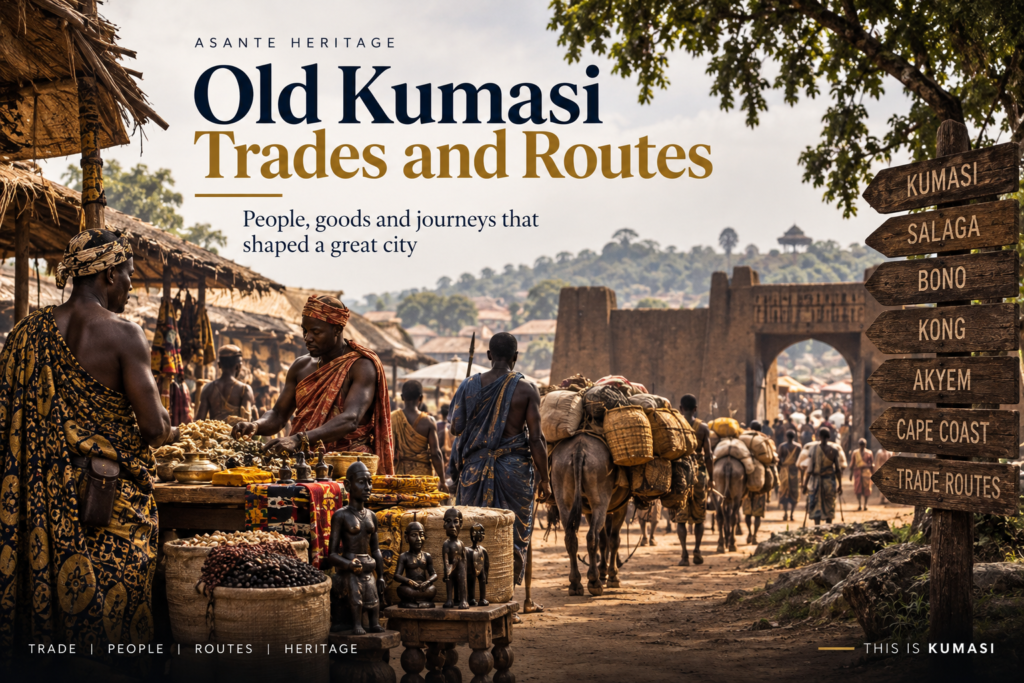
Old Kumasi Trades and Routes: How Commerce Helped Shape the Asante Capital
Long before Kumasi became the sprawling commercial city of markets, highways, transport stations and modern businesses that we know today, it was already an important centre of trade.
As the capital of the Asante state, Kumasi stood at the centre of a network of roads that connected the forest belt with markets to the north, neighbouring Akan territories and trading centres toward the coast.
These were not roads in the modern sense.
There were no asphalt highways, trucks or buses carrying goods from one region to another. Traders, officials, messengers and porters travelled largely on foot, following established routes through forests, towns and settlements.
Yet these old roads helped make Kumasi powerful.
They carried kola nuts, gold and other commodities, but they also carried people, information, political messages, religious influences and cultural ideas.
To understand the rise of Kumasi as one of West Africa’s great historic cities, it is important to understand the trade routes that once led into and out of the Asante capital.
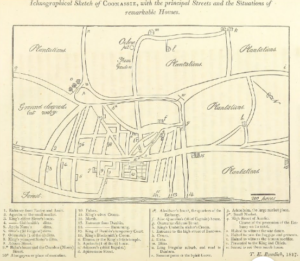
Kumasi at the Heart of Asanteman
Kumasi’s importance was closely tied to the growth of the Asante state from around the beginning of the eighteenth century.
As Asante expanded politically, Kumasi developed as its royal and administrative centre.
The city was the seat of the Asantehene and the heart of an increasingly organised state whose influence reached far beyond the immediate surroundings of Kumasi.
But political authority was only part of the story.
Kumasi also occupied an advantageous position within regional trade.
To the north lay the savannah and long-distance commercial networks involving communities such as the Hausa, Mande, Gonja and Mossi.
To the south were the Akan territories and the Atlantic coast, where European trading forts had become important points of exchange.
The Asante capital stood between these worlds.
Goods arriving from one direction could move through Asante toward another, while products from the forest zone could be sent to markets far beyond Kumasi.
This made the city not simply a royal capital but an important commercial crossroads.
Roads Radiating From the Capital
Historic Kumasi was connected to surrounding territories through an extensive road network.
Major routes linked the capital with important towns, provincial centres and external markets.
Travellers leaving Kumasi could head north toward the Bono and savannah regions, west toward important trading areas in what is now eastern Côte d’Ivoire, or south toward the coast.
These routes were important to both commerce and government.
A road could carry traders with kola and gold.
The same road could carry royal messengers with instructions from the Asantehene.
It could also be used by officials, ambassadors or military forces.
Control over roads therefore mattered greatly to the Asante state.
Trade routes were economic assets, but they were also instruments of political power.
The Great Northern Trade
One of the most important branches of Asante commerce was the northern trade.
During the nineteenth century, Asante traders exchanged goods with Hausa, Mande and Mossi caravan traders at important commercial centres.
Among these were Bonduku, in what is now eastern Côte d’Ivoire, and Salaga, which became one of the great trading centres of the northern Gold Coast.
After major political changes in 1874, Kintampo became increasingly important as a transit market for Asante’s northern trade.
These trading relationships connected Kumasi with commercial networks extending much farther into West Africa.
A commodity produced in the forest areas around Asante could therefore travel hundreds of kilometres before reaching its final consumer.
Of all the products that moved through these networks, one was especially important.
That product was kola.
Kola: One of Asante’s Great Trading Commodities
Kola nuts became one of the foundations of Asante’s northern trade.
The trees thrived in the humid forest zone, including areas controlled by or connected with Asante.
Farther north, however, kola was highly valued.
The nuts were consumed socially and valued by travellers and merchants. Demand for them in the savannah and Sahel created a natural trading relationship between the forest regions and northern markets.
Asante traders collected and distributed kola, sending large quantities toward commercial centres such as Salaga and Bonduku.
There, kola could be exchanged with traders arriving from farther north.
The importance of this commerce meant that the kola tree growing in a humid forest community could become part of an economic system stretching far beyond Asanteman.
Long-distance traders helped link Kumasi with communities speaking different languages and following different cultural and religious traditions.
In this way, kola did more than generate wealth.
It connected worlds.
Salaga and the Northern Commercial Network
For much of the nineteenth century, Salaga was one of the most significant commercial centres connected to the northern trade.
Its market brought together merchants from different parts of West Africa.
Asante traders could meet Hausa, Mande, Mossi and other merchants within these northern networks.
Kola from the forest zone was exchanged for products originating from the savannah and other regions.
The market therefore functioned as a meeting point between different economic zones.
Salaga’s significance demonstrates just how far Kumasi’s commercial relationships extended.
The old Asante capital was not isolated within the forest.
It was plugged into a much larger West African economy.
Bonduku and the Western Trade
Another important centre was Bonduku, historically associated with long-distance trade west of the Asante heartland.
Bonduku connected Asante commerce to Mande trading networks and territories farther west and north.
Like Salaga, it served as a point where merchants from different regions could exchange commodities.
These relationships remind us that modern national borders did not define commercial life in the way they do today.
The people who traded across West Africa moved within networks that long predated the creation of Ghana, Côte d’Ivoire, Burkina Faso and other modern states.
Historic Kumasi’s economic world therefore extended beyond the boundaries we recognise on today’s maps.
Gold and the Asante Economy
Alongside kola, gold occupied a central place in Asante economic and political life.
The wider Akan forest region had been associated with gold production and trade for centuries before the rise of Asante.
Gold helped attract European traders to the coast and contributed to the region becoming known internationally as the Gold Coast.
Within Asante itself, gold served several purposes.
It represented wealth and prestige.
It was connected with royal power.
It was used in ornaments and court regalia.
And importantly, gold dust could function as currency.
Market transactions could involve carefully weighing small quantities of gold dust against established gold weights.
This required specialist knowledge.
Buyers and sellers needed scales and recognised weights to determine the value involved in a transaction.
The beautiful brass gold weights preserved today are therefore not merely decorative objects.
They belonged to a sophisticated commercial system.
Many of these weights were shaped in forms carrying proverbs, symbols, animals and scenes from everyday life, linking trade directly with Akan artistic and philosophical traditions.
What Kumasi Exported
Historical accounts show that Asante’s economy involved more than one commodity.
By the late nineteenth century, products associated with Asante included kola nuts, gold, palm oil, cotton and gum copal, among others.
The importance of individual products changed over time.
Market demand also changed as regional and international economies developed.
What remained important was Kumasi’s role as a centre through which commodities could be assembled, traded and redistributed.
A product might originate in a village far from the capital, move toward Kumasi through local markets and then continue along a long-distance trading route.
The city’s importance therefore depended not simply on what was produced inside Kumasi itself.
It depended on its ability to connect producers, traders and markets.
Goods Moving Into Asante
Trade was never one-way.
As forest products moved outward, goods from other regions entered Asante.
Northern commercial networks supplied a variety of savannah products and manufactured goods.
Trade with coastal areas brought additional commodities into the interior.
As connections with Atlantic commerce expanded, imported items such as cloth, firearms and other manufactured products became increasingly important within the regional economy.
Kumasi therefore became a place where goods from very different environments and commercial systems could meet.
Forest products could exchange hands beside commodities originating hundreds or even thousands of kilometres away.
Trade Toward the Coast
The northern routes were only one part of the story.
Asante also maintained important commercial connections toward the south.
Routes linked the interior with coastal areas and trading centres associated with places such as Elmina and Cape Coast.
European forts along the coast had developed into important points of Atlantic commerce.
Gold and other inland commodities could move south, while imported goods travelled north toward the interior.
Control over access to coastal trade became politically important.
Competition over trade routes and coastal relationships would eventually contribute to repeated tensions between Asante and neighbouring states, as well as conflicts with British colonial interests.
Commerce and politics were therefore closely intertwined.
A road carrying goods could also become the subject of diplomacy, rivalry or war.
Kumasi as a Marketplace
Inside Kumasi itself, markets formed an important part of everyday economic life.
Farmers, craftspeople and traders brought goods into the capital from surrounding communities.
Long-distance traders added commodities arriving from farther away.
The marketplace became a place where different layers of the economy met.
Locally produced food could be sold alongside cloth, crafts, imported goods and long-distance trading commodities.
Markets were also social spaces.
News travelled through them.
Prices were negotiated.
Relationships were formed.
Information about events in distant places could arrive with travellers and merchants.
The market therefore functioned almost as an information network.
Long before radio, television, mobile phones or social media, people carrying goods between towns also carried stories.
The Role of Market Women
Women have long played major roles in Ghanaian commercial life, and markets were central spaces of female economic activity.
Women operated as retailers and traders, connecting agricultural producers with consumers and helping distribute goods throughout towns and neighbourhoods.
That tradition remains highly visible in Kumasi today.
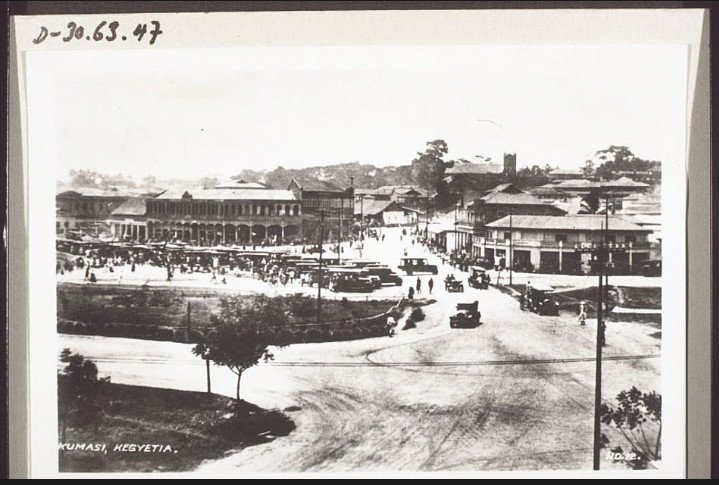
The presence and economic influence of women in places such as Kejetia and other markets should therefore not be viewed simply as a modern phenomenon.
It belongs to a much longer history of women participating actively in the commercial life of the city and region.
Travelling Before Cars and Lorries
Moving commodities in precolonial Asante required considerable labour.
There were no trucks transporting tonnes of goods overnight.
Human porterage was fundamental to long-distance transport.
People carried loads along established paths, often travelling for many days.
A journey that can now be completed in a few hours might once have required repeated stops.
Communities located along major routes therefore played important roles.
Travellers needed food.
They needed places to rest.
Traders needed markets where they could exchange goods or obtain supplies.
Over time, settlements strategically positioned along trade routes could grow in economic importance.
The route itself created opportunity.
Trade, Language and Cultural Exchange
Merchants did not move only commodities.
They carried culture.
When people from Kumasi travelled north, they encountered communities with different languages, customs and religious traditions.
Northern merchants travelling toward Asante experienced the same thing.
Commercial centres became multicultural spaces.
Hausa and other Muslim merchants participated in long-distance trade across West Africa, helping create communities connected by both commerce and Islam.
These relationships contributed to the movement of religious ideas and forms of literacy.
Trade therefore helped expose Kumasi and the wider Asante world to influences from well beyond the forest belt.
The Difficult History of Enslaved People
The history of these trade networks also contains a painful chapter that should not be ignored.
Enslaved people were part of regional commerce.
Salaga, in particular, became one of West Africa’s significant slave markets during the nineteenth century.
People captured through warfare and other forms of coercion could be sold and transported through commercial networks.
Some remained within African societies, while others were moved over considerable distances.
Asante itself participated in systems of slavery and slave trading during different periods of its history.
That reality belongs beside the stories of kola, gold and commercial prosperity.
The old trade routes were places of opportunity and cultural exchange, but for some people they were also roads of forced movement and suffering.
A complete account of Asante commercial history must acknowledge both sides.
Trade and the Power of the Asante State
Commerce provided resources that strengthened political power.
The Asante government had an interest in managing economic relationships and maintaining secure access to important routes.
Trade generated wealth.
Wealth could support political administration, diplomacy and military activity.
At the same time, Asante political authority helped create conditions in which commerce could operate across a large territory.
The relationship worked in both directions.
Political power supported trade, and trade supported political power.
This connection helps explain why control of strategic towns and roads mattered so much in Asante history.
Roads Also Carried Government
The roads leading from Kumasi were not exclusively commercial.
They were also the communications infrastructure of the kingdom.
Royal messengers carried information between the capital and other areas.
Officials travelled along them.
Tribute and resources could move toward Kumasi.
Diplomatic delegations travelled between courts.
Military forces could use the same routes during periods of conflict.
Seen this way, Kumasi sat at the centre of a network through which the Asante state communicated with the territories around it.
The roads functioned almost like the veins and arteries of the kingdom.
The Turning Point of 1874
The year 1874 marked an important turning point in Asante history.
British forces invaded Kumasi during the Anglo-Asante conflicts, and the political consequences affected Asante’s regional influence and commercial relationships.
The disruption contributed to changes in long-established trading patterns.
Research into Asante’s northern trade shows that while places such as Salaga and Bonduku had previously played major roles, Kintampo became particularly important as a trading centre between 1874 and the early 1890s.
Trade did not simply disappear.
Instead, traders adapted.
Routes changed.
Markets gained or lost importance.
Commerce found new paths.
This ability to adjust to political change would continue to shape Kumasi’s economy.
From Kola to Cocoa
The commercial knowledge developed through older trading systems also mattered when new economic opportunities emerged.
By the late nineteenth and early twentieth centuries, cocoa began transforming the economy of the Gold Coast.
The networks, experience and entrepreneurial traditions developed through commodities such as kola helped provide a background for participation in new forms of trade.
Kumasi would eventually become closely connected with the cocoa economy of colonial and postcolonial Ghana.
The commodities changed, but commercial experience remained.
Colonial Roads and New Transport
Colonial rule dramatically altered transportation.
The early twentieth century brought attempts to construct more permanent roads connecting Kumasi with northern areas.
Road building gradually reduced dependence on older footpaths and porterage.
Motor vehicles later transformed both the speed and scale at which goods could travel.
Journeys that once involved large groups of porters could increasingly be completed by lorry.
This reshaped old commercial relationships.
Some settlements grew because new roads passed through them.
Others lost importance when transport routes changed direction.
The geography of trade continued to evolve.
The Railway and a New Commercial Era
Rail transport also transformed Kumasi.
The extension of the railway into the Asante region connected Kumasi more directly with southern Ghana and the coast.
Railways could move much larger quantities of goods than traditional porterage.
This became particularly important as cocoa, timber and other export commodities expanded.
Kumasi remained a commercial centre, but the machinery of trade had fundamentally changed.
The old trader walking a forest road with a caravan of porters gradually gave way to trains, motor lorries and modern transport stations.
From Historic Markets to Kejetia
Perhaps one of the clearest signs of Kumasi’s commercial continuity is the importance of Kejetia.
Modern Kejetia and the wider central market area represent a new scale of commerce, but the underlying principle is familiar.
People come from different places.
Goods converge.
Traders redistribute them.
Transport routes connect the city with the rest of Ghana and neighbouring countries.
The products are different.
The technology is different.
The city itself has changed dramatically.
But Kumasi remains what it was centuries ago:
a meeting point for people and trade.
Adum and the Modern Commercial City
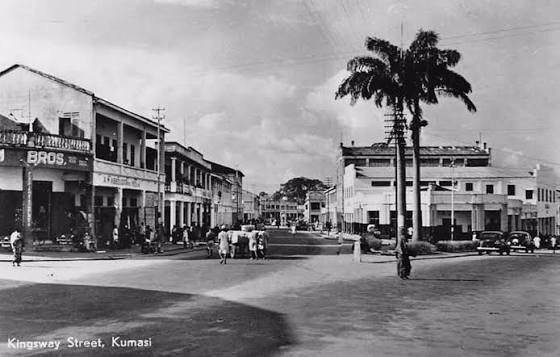
Adum similarly reflects Kumasi’s evolution into a modern business centre.
Banks, shops, offices, retailers and traders now occupy streets where commercial activity takes place on an entirely different scale from the old Asante capital.
Electronic payments and mobile money have replaced the careful weighing of gold dust.
Trucks transport goods that once required many porters.
Phones allow traders to negotiate with suppliers without leaving their shops.
Yet the culture of commerce remains deeply embedded in the city.
Kumasi still wakes up to trade.
Why the Old Routes Matter
The old trading roads are important because they help explain why Kumasi became the city it is.
Kumasi did not grow simply because it was chosen as a political capital.
It grew because it was connected.
Its roads reached outward toward farming communities, gold-producing areas, neighbouring kingdoms, northern caravan markets and the Atlantic coast.
Through those connections came wealth and opportunity.
Through them also came competition, conflict and exploitation.
But together they made Kumasi part of a much larger economic world.
A West African City Connected to the World
It is tempting to imagine precolonial African cities as isolated places disconnected from international commerce.
The history of Kumasi shows otherwise.
The Asante capital participated in trading networks stretching across different ecological zones and political territories.
Its merchants dealt with traders linked to wider West African commercial systems.
Its gold connected it to Atlantic commerce.
Its kola travelled north.
Imported goods travelled inland.
Ideas moved with people.
Kumasi was therefore part of a connected regional economy long before modern globalisation gave us airports, container ships and online shopping.
The Legacy in Modern Kumasi
Today, someone standing in central Kumasi may see taxis, buses, delivery motorcycles, trucks and crowds of shoppers moving through the city.
The scene looks completely different from Kumasi two centuries ago.
Yet there is a historical continuity.
Goods still arrive from different regions.
Traders still travel to Kumasi because of its markets.
Businesses still depend on transport connections.
People still come to the city to buy products they cannot easily find elsewhere.
Kumasi remains one of Ghana’s most important commercial centres.
The old trade paths may have disappeared beneath roads and buildings, but the economic character they helped create has survived.
A City Built Along the Roads of Trade
The history of old Kumasi is often told through kings, wars and royal institutions.
Those stories are important.
But there is another Kumasi in the historical record.
It is the Kumasi of the trader.
The porter.
The kola producer.
The gold dealer with his scales.
The market woman.
The craftsman.
The foreign merchant arriving after a long journey.
The messenger walking away from the royal capital.
The communities that grew beside the routes.
Together, these people helped build the economic life of Asanteman.
For generations, roads from different directions converged on Kumasi.
Along them came gold, kola, goods, people, news and ideas.
And along those same roads, the influence of the Asante capital travelled outward.
That is why the story of Kumasi’s old trade routes is more than a history of buying and selling.
It is the story of how connections helped create a great city.
Quick Facts About Old Kumasi’s Trade
Historic Centre: Kumasi
Political State: Asante
Major Forest Commodity: Kola nuts
Other Important Products: Gold, palm oil, cotton and gum copal
Major Northern Trading Connections: Bonduku, Salaga and later Kintampo
Trading Communities: Asante, Hausa, Mande, Mossi and others
Historic Currency: Gold dust was widely used in Asante transactions
Transport: Long-distance travel depended heavily on human porterage and established foot routes
Major Commercial Direction: Northern savannah markets and southern/coastal trade networks
Key Historical Change: Political disruption after 1874 contributed to shifts in established trade patterns
Explore More Kumasi and Asante History
The history of Kumasi’s trade routes connects with many other stories in the Asante Culture Archive.
Explore the history of the Asante Kingdom, the Golden Stool, the kola trade, Asante gold weights, Kejetia Market, Salaga, Kente, Adinkra, Manhyia Palace and the transformation of Kumasi from a royal capital into a modern commercial city.
The old routes may have changed.
The traders may now travel by car, bus and truck.
But Kumasi remains a city shaped by movement, exchange and commerce.
19 views